Nothing to pay until your first invoice. No card, no demo, no form.
Acme Co · SeptemberHeld
41.5of 40 h
Tue 8 Sep · 1.5 h · Board deck · Maya R.
Held for approval. 1.5 h over the client’s budget.
ApproveDecline
0.1%
of what you invoice
$0
to pay until your first invoice
1 min
a day to log hours, from Slack
0
demos, sales calls or forms
No more surpriseson timesheets or invoices.
An hour that would push a client over budget doesn’t slip through. Ceed marks it pending approval and asks you. Yes, and it goes on the invoice at the agreed rate. No, and it stays on the record, unbilled. Either way you decided, and you decided today.
Logged
1.5 h · Acme Co · Board deck
Pending approval
Over the 40 h budget. Waiting for Dana.
Approved
On the September invoice, at the agreed rate.
Two hours past Acme Co’s budget. The reason typed. Your call.
One set of hours.Everything follows.
Your team logs hours once. The invoice, the payouts, the margin and the close all come from those same entries.
The invoice comesfrom the agreement.
Retainer, budget, rates by role, discounts. Computed from what the client signed, so the invoice matches the agreement.
Invoice · Juniper Robotics · August 2026Computed
Retainer for August · 120 h$120,000.00
Equity taken as payment, per the agreement−$12,000.00
Due 30 Sep$108,000.00
Goes to your ledger as a document.
Margin per client.This morning.
Revenue, cost and margin for every client, every day, from the hours as they are logged.
Margin · September so farThis morning
Acme Co61%
Juniper Robotics55%
Northwind Foods42%
The firm53%
Visible to the owners and whoever they name.
Payouts fromthe same hours.
The contractor’s statement and the commission come from the same entries as the invoice. Nothing to reconcile.
Maya R. · payout · AugustComputed
Acme Co · 38.5 h$5,775.00
Juniper Robotics · 62 h$9,300.00
Owed · 30 Sep$15,075.00
The same 100.5 hours the two invoices used. Your payment rail moves the money.
Equity as payment.On the books.
Shares taken as fees show on the invoice and in the record, at the value you agreed.
Juniper Robotics · shares as feesOn the books
July invoice−$12,000.00
August invoice−$12,000.00
Shares, at the agreed value$24,000.00
Closed means closed.
Close the month and its invoices, statements and margin freeze. Nothing in it changes after.
August 2026Closed
Invoices, computed5
Payout statements4
Margin for August52%
Closed by Dana K., Wed 2 Sep. Nothing in it changes.
One Slack remindera day.
Each workday, a message with the hours left per client. No timers, no screenshots. Everyone sees their own hours.
Slack · #hoursEvery workday
Ceed · Fri 11 Sep, 4:30 pmHours left this month. Acme Co 0, with 1.5 h held. Juniper Robotics 14.0. Northwind Foods 61.0. Log today’s hours.
The client sees the fee.You see the hours.
A retainer is a flat fee. You sized it in hours only you know. Ceed keeps that number, so scope creep shows up as a held hour, not as a thinner month.
What the client sees
Invoice · Acme Co · August 2026Paid
Retainer for August$10,000.00
Paid 30 Sep$10,000.00
One line. The hours behind it stay with you.
What you see
Acme Co · AugustWithin budget
38.5of 40 h
Budget40 h
Logged38.5 h
Margin61%
The budget you sized the fee with, and the margin it left.
Know in September.Not in October.
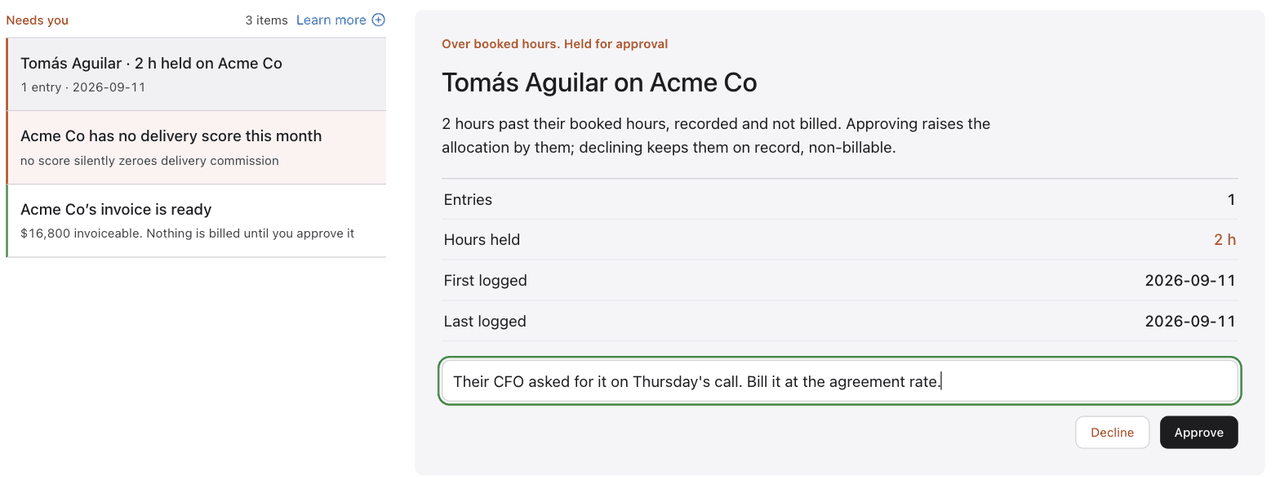
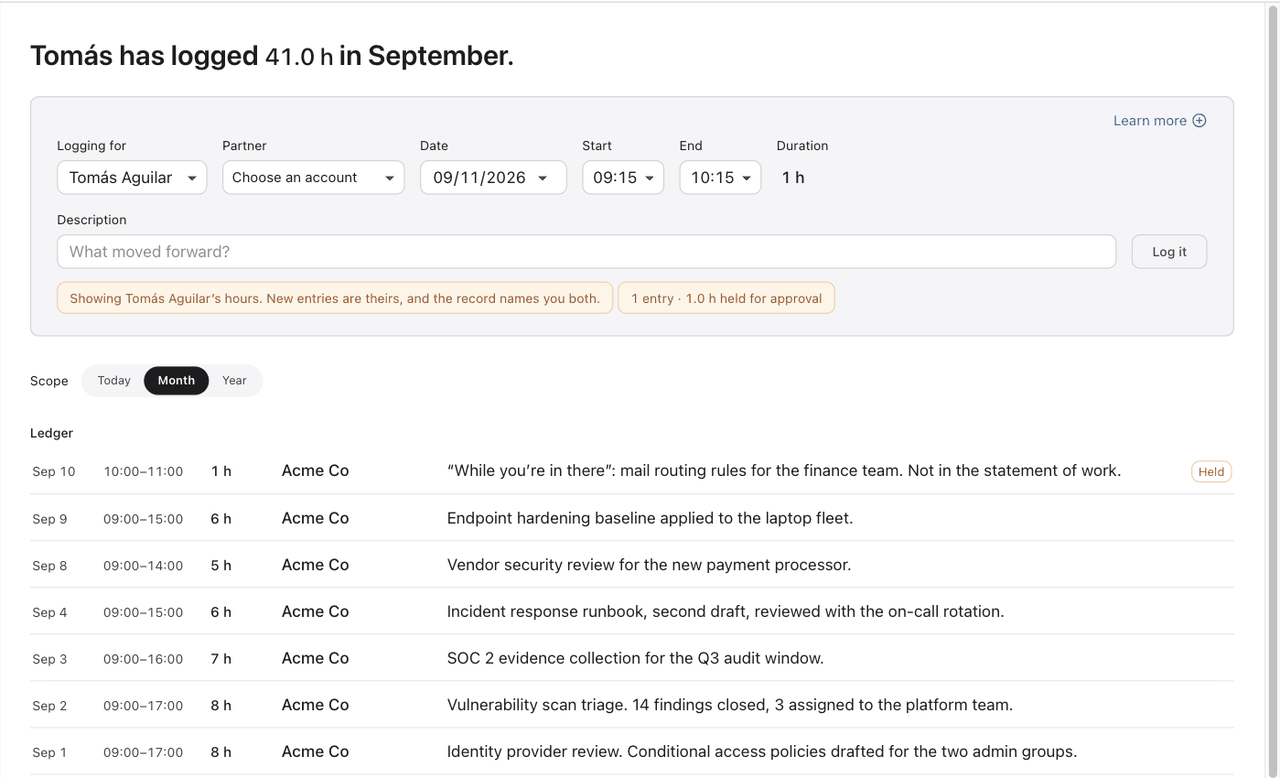
On the tenth, Acme Co asked Tomás for one more thing while he was in there. He did the work and he logged the hour. Elsewhere, that hour is worked for free and found at the invoice, a month late.
While you’re in there.Held.
The forty-first hour against a budget of forty, for a task the statement of work never mentioned. Ceed held it the moment Tomás logged it and asked you. It sits in the row where it happened, unbilled, until you say yes or no.
The invoice waits.For you.
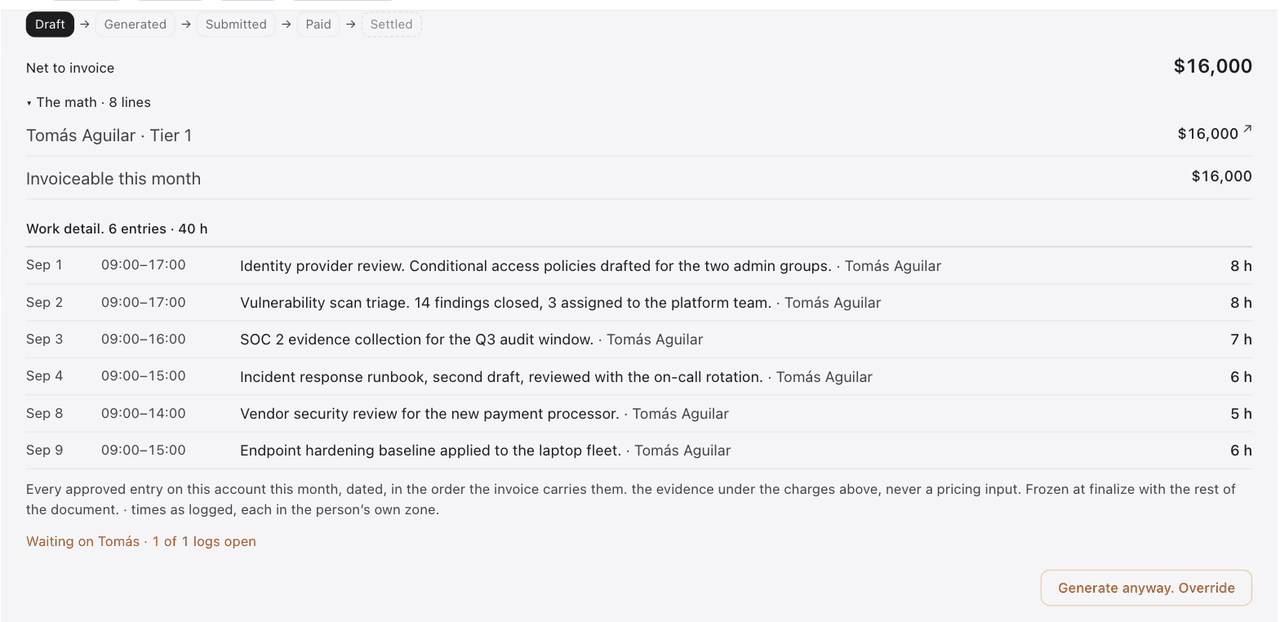
$16,000, computed from forty approved hours at the agreed rate. Under the number, six days of work, dated, in Tomás’s own words, for anyone who asks what the money bought. The held hour is not on it, and the invoice stays a draft until you decide.
Still September.Already the margin.
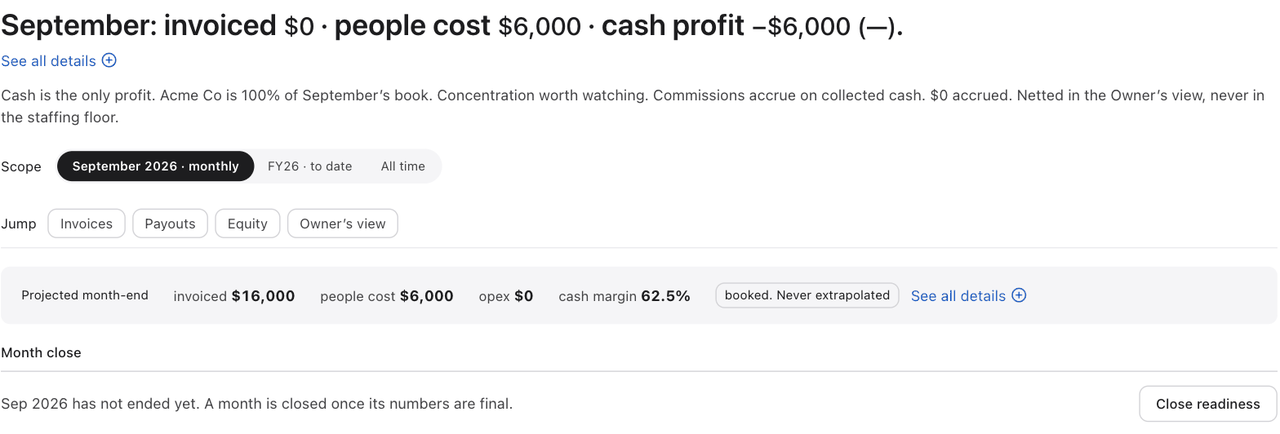
On the eleventh the month reads minus $6,000. Nothing is invoiced yet and Tomás has cost that much. Beside it, what is booked: $16,000 to invoice and a 62.5% cash margin, never extrapolated. The question you carry to the close, did we make money, is answered with three weeks to run.
Your firm has its own tenth of the month. Sign up and that hour waits for your decision.
Nothing to pay until your first invoice. No card, no demo, no form.
Sign up.Then the first hour.
Three steps from this page to a budget that holds at the hour.
1 · Sign up
Continue with your work Google account. The first sign-in creates your firm.
2 · The clients
Add a client, its budget in hours and the rates. Or upload the agreements you signed and Ceed Intelligence reads them in.
3 · The hours
Your team logs hours from Slack, one reminder a day. The hour past a budget waits for you.
Bring the firm you have.Ceed Intelligence reads it in.
Your people list, your W-2s and 1099s, your client list and the agreements you signed. Ceed Intelligence reads them and proposes the people, clients and budgets it found. You confirm, all at once or row by row.
It works anywhere you use Ceed, in your own words: log two hours on Acme Co, which clients are over budget, prepare the August invoice. It proposes, you confirm, and every act shows its price first.
Your CRM, project tool, chat, ledger and payroll stay where they are. Ceed is the record they all work from.
We ran a security consultancy on those spreadsheets. We caught over-servicing at month close, we surprised a client with an invoice, we paid partners from a sheet we hoped was right. So we built the system we needed and ran our own books on it first.
Jon McLachlan and Sasha Sinkevich, founders of YSecurity and Ceed
Sasha Sinkevich and Jon McLachlan. YSecurity runs its books on Ceed.
Questions.Answers.
What is Ceed?
Time tracking, client budgets, invoices, contractor payouts and the month close for a firm that bills for its team’s time. When an hour would push a client over budget, Ceed holds it for your approval the moment it is logged. It costs 0.1% of what you invoice.
What does it cost to sign up?
Nothing. Ceed charges 0.1% of what your firm invoices, starting with your first invoice. A month with no invoice costs nothing. No seats, no tiers, no minimum.
How do we sign up?
With a work Google account. The first sign-in creates your firm. There is no demo, no sales call, no form and no card to enter. Questions go to hello@ceed.so and a person replies.
Who is Ceed for?
Consultancies, agencies, fractional CFO and CISO practices, IT and security service providers, law firms and staffing firms, from two people to about fifty. Any firm that bills clients for its team’s time. Nineteen kinds of firm have a page each.
What does Ceed replace, and what stays?
Ceed replaces the timesheet spreadsheet, the retainer math, the invoice typed by hand and the month-end reconciliation. Your accounting ledger, your project tool, your chat and your payroll stay where they are.
How does the hold work?
When an hour would push a client over budget, Ceed saves it and marks it held. The account leader or an owner approves or declines it. Approved, it goes on the invoice at the agreed rate. Declined, it stays on the record and is not billed. Nothing is refused at the door and nothing disappears.
Do our clients see the hours?
Only what the agreement puts on the invoice. A flat retainer invoices as a flat retainer. The hours behind it, and the budget you sized it with, are yours to see.
Is Ceed a way to watch the team?
No. Ceed watches each client’s budget, not the person. One Slack reminder a day, no timers, no screenshots. Everyone sees their own hours.
Why a share of invoices instead of seats?
Because the fee should rise and fall with your firm. A month you invoice nothing costs nothing, and adding a person costs nothing. The rate never moves.
Does Ceed connect to Slack, QuickBooks or Xero?
Slack is where hours are logged, from one reminder a day. Invoices and statements come out of Ceed as documents for the ledger you already use.
Does Ceed touch our money?
No. Ceed is the record. Your bank moves the money and your payroll provider pays your people.
Does Ceed use AI?
Yes. Ceed Intelligence is part of Ceed, anywhere you use Ceed. It reads your files into the record, turns a sentence into the act and answers with your numbers. It proposes, you confirm, and every act shows its price. Every number on an invoice is still computed from the agreement and the record, the same way every time.
Can Ceed Intelligence set up our firm from what we already have?
Yes. Give it your people list, your W-2s and 1099s, your client list and the agreements you signed. It reads them and proposes the people, clients and budgets it found. You confirm, all at once or row by row, and every record it added says so. Rates and other money terms wait for your yes, one by one.
What does Ceed Intelligence cost?
What the model costs, shown on every act before you confirm it and as its own line on your statement. Or run it on your firm’s own account with the model provider. The 0.1% does not move, and Ceed works without it: every rule and number holds on its own.
Couldn’t our own AI build this?
Most of it, in a weekend. Not the rule that holds an hour the moment it is logged, not who may see rates and margin enforced on the server, not the month that cannot be rewritten, and not a vendor who answers for the invoice.
What happens when a month closes?
The invoices, the statements and the margin for that month are frozen as a record, and nothing in it changes after. Every edit before the close sits on a trail nobody can rewrite.
Where does our data live?
In your firm’s own tenant. Client names never leave it. Rates and margin are visible only to the owners and the people they name, enforced on the server, and everyone sees their own hours.